

Finned tube radiator is a kind of heat exchanger widely used in gas and liquid heat exchangers. It realizes the effect of heat transfer enhancement by adding fins on the general base tube. The base pipe can be steel pipe; Stainless steel pipe; Copper pipe, etc. Steel strip can also be used for fins; Stainless steel strip, copper strip, aluminum strip, etc.
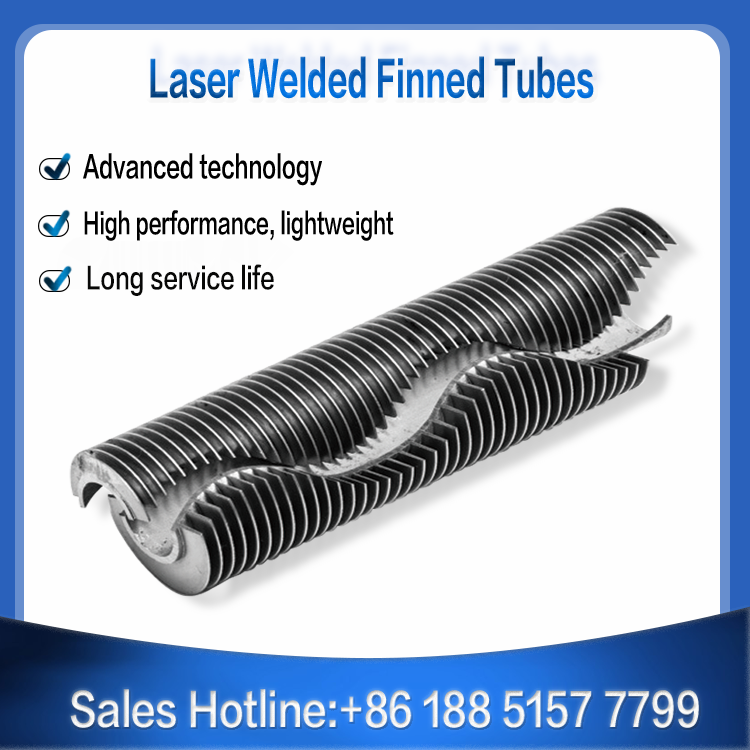
Finned tube radiator performance characteristics: 1. Large heat dissipation area, high heat dissipation efficiency, fast temperature rise, small temperature difference. 2 Finned tube radiator has high corrosion resistance and high pressure resistance. Finned tube is a kind of ribbed wall, which is widely used in power, chemical and other industries. Many spiral heat exchange surfaces or threaded tubes can also be regarded as finned tubes. It plays a significant role in expanding the heat transfer area and promoting turbulence, both for single-phase convection heat transfer and phase change convection heat transfer. The structure of finned tube heat exchanger is basically the same as that of ordinary shell and tube heat exchanger. The finned tube is used instead of the smooth tube as the heat transfer surface. Due to the enhanced heat transfer and compact structure, it can be made into a compact heat exchanger; Finned tube heat exchanger is also often used to heat or cool the gas outside the tube, while steam or water is used in the tube, such as air cooler, boiler economizer, radiator, etc.
The finned tube heat exchanger uses steel aluminum composite finned tube as the main heat exchanger element. Due to the advanced composite process, there is basically no contact thermal resistance when the temperature in the pipe is below 210 degrees. Finned tube radiator combines the pressure resistance of steel pipe with the high thermal conductivity of aluminum, and has excellent heat transfer performance. At the same time, it avoids direct contact between steel pipe and air, and its corrosion resistance is improved. Since the fins have no wrinkles, the air resistance is lower than that of the winding type. At the same time, the utility model has the advantages of easy cleaning, compact structure, large unit heat transfer area, etc. Finned tubes have high heat transfer efficiency. Because the boundary layer is constantly broken due to the disturbance of the fins to the fluid, they have large heat transfer coefficients; At the same time, because the baffle plate and fins are very thin and have high thermal conductivity, the fin heat exchanger can achieve high efficiency. Because the fin heat exchanger has an extended secondary surface, its specific surface area can reach 1000 ㎡/m3. It is light, because it is compact and mostly made of aluminum alloy. Now steel, copper and composite materials have also been mass produced.